
Welcome to our new blog series “Become a Better Paddler”!
My goal with this series is to provide you with the tools to develop your paddling technique. I hope this will inspire more people to take the step and learn more. Regardless of your skill level, I hope you will appreciate and find something that helps you progress in your continued development on the water!
In this series, we will dive deep into various aspects of sea kayaking. We will work with one theme per month, and each blog post will be complemented by video(s) on YouTube and posts on our Facebook & Instagram.
There will be a significant focus on paddling technique, and I want to remind you that whether you aim to be the world’s best kayaker or your goal is to paddle a loop around Kungsholmen, good technique is an investment that quickly pays off. If you want to be the best, it is a necessity. If you just want to get out and discover the water, technique will be decisive for how efficiently you move and how safe you feel in various, often stunningly beautiful, environments.
The Technique Pyramid
Before we start looking at specific techniques, I want to introduce something that the Swedish Canoe Federation’s education committee has developed as a tool for analyzing paddling. We call it the Technique Pyramid.
![The Technique Pyramid consists of:
Foundations [equipment, physical, position, mental, contact]
Power Transfer [Water, Body]
Directing Power [Paddle, Kayak]
Optimization [feeling]](https://lekmer.nu/wp-content/uploads/2025/01/teknikpyramiden-png.avif)
This is just one model, and there are several others you can choose to use if you prefer. In this series, however, we will use the Technique Pyramid, so it might be wise to read on to gain an understanding of what it is and what it is intended to do.
What is the Technique Pyramid?
The Technique Pyramid is a model used in sea kayaking to understand and improve paddling technique. It breaks paddling down into basic components and highlights how these elements interact. The purpose of the pyramid is to provide a framework for both analyzing and developing paddling skills, which contributes to a more efficient, safe, and enjoyable experience on the water.
The different parts of the pyramid collectively contribute to good paddling technique. Each part can also be studied individually, which means that using the parts of the pyramid, we can analyze a paddler to identify areas for growth.
By understanding and training different parts of the pyramid, you as a paddler can develop systematically, whether you are a beginner or experienced. The pyramid can be used to create exercises focused on specific areas and to analyze paddling technique, making it easier to pinpoint which area can be improved.
Parts of the Pyramid
The Technique Pyramid is divided into four different parts, each with its respective components.
- Foundations These are the essentials needed for paddling, the base of the pyramid. This includes having the right equipment for the paddler and the environment, as well as the paddler’s physical and mental state. A good position in the sea kayak is a vital foundation.
- Power Transfer involves how the body moves to transfer energy from the body to the water to propel the sea kayak forward.
- Directing Power focuses on how we use our paddle and sea kayak to apply and direct the power we create correctly.
- Optimization is about how all parts of the paddle stroke are interconnected. It concerns the timing of movements, the ability to adjust the paddling tempo, and engaging or relaxing various muscle groups.
Foundations

Foundations are the base of the pyramid and of paddling itself. If you lack any of these, it becomes difficult to paddle in an efficient and safe manner. When I work as an instructor and something isn’t working for one of my students, this is always where I start looking. Are there any of these boxes we need to focus on?
If you join us for a safety course or learn from another authorized educator, these are typically the areas we work on at the yellow level of the “Paddelpasset” (Paddle Pass).
Below is a description of each part of the foundations.
Equipment
To be able to paddle at all, the right equipment must be in place. Correct equipment varies depending on where and when you paddle, but as a base, a paddle of appropriate length, a sea kayak that fits you well, and a PFD (Personal Flotation Device) adapted for paddling are essential foundations.
Physical
Your physical ability significantly impacts how well you can propel the sea kayak. The physical aspect is not just about strength; we also look at:
- Balance is your ability to maintain equilibrium. Having good balance makes it easier to handle waves and other conditions encountered during sea kayaking in Sweden. In a sea kayak, basic balance comes from the hips, and we stay stable by keeping our center of gravity within the width of the sea kayak. A proper sitting position with good contact contributes to excellent balance.
Without balance, it becomes difficult for a paddler to develop good paddling technique. It also makes it harder to stay in a positive mental state, as your focus quickly shifts to keeping the sea kayak on an even keel. - Endurance is something every paddler needs. For those of us who don’t compete but are out for the experience and adventure, good fitness helps increase safety during your journey. Good endurance also makes your Bohuslän kayaking adventure through the granite skerries more enjoyable.
- Strength allows us to execute our paddle strokes and propel our sea kayak forward. The stronger you are, the more power you can put into your strokes. When combined with good paddling technique, this creates efficient forward drive. Good core strength also reduces the risk of injury. In sea kayaking, strength and stability in the core and shoulders are the most vital muscle groups.
- Motor skills & coordination are about your ability to synchronize different movements. Sea kayaking is a blend of several more or less complex movements that require motor skills and coordination to master.
- Mobility is essential both for executing proper paddling technique and for avoiding injuries. When paddling, it is important to have good mobility in the thoracic spine and hamstrings. If your legs are too tight, it becomes difficult or impossible to maintain a good position in the sea kayak. A poor sitting position makes it hard to achieve good technique.
Position
A good position creates the foundation for efficient paddling. It provides the correct balance, strength, and the ability to move freely.
When sitting in your sea kayak, you want a forward-rotated pelvis with a slight arch in the lower back. You should sit with good posture and preferably a slight forward lean. To sit comfortably in the right position, your sea kayak needs to be correctly adjusted. Your footrests should be at a distance where you have good support and can maintain contact with your sea kayak through your feet, buttocks, and knees.
Correct sitting position leads to better control and balance in your sea kayak. If you find it difficult to sit well, it may be due to the following:
- Overly tight hamstrings
- Weak core muscles that cannot support the body
- A seat that does not fit your body and therefore does not provide proper support
- Footrests positioned too far away.
Another common “error” in positioning is sitting with forward-rotated shoulders. This can lead to shoulder issues and often results in jutting the head forward, which can cause neck discomfort.
To achieve a good shoulder position, you may need to train the muscles around the shoulder blades and stretch the chest muscles and the latissimus dorsi.
In addition to sitting position, hand placement is important to consider. In all paddling techniques, you want slightly bent arms and to look in the direction you are paddling.
Mental State
Being in the right mental state is not a strict prerequisite for being able to paddle. However, if you want to develop your skills and learn more, it is important to be in a good mental place. By being present in the moment, interested, and curious, you can stimulate your ability to absorb information.
When I, as an instructor, notice that the mental aspect is missing, it is often due to fear or anxiety. A person who is afraid is in survival mode, making it very difficult for them to process information. Therefore, I always work hard to create a safe environment when I lead a safety course and ensure that, especially when out with beginners, everyone has sea kayaks they feel secure in.
Contact
Last on the list of prerequisites is the contact between the body, the sea kayak, and the paddle. But also the contact of the paddle and the sea kayak with the water.
Good contact provides the right conditions for the power transfer from your body into the water through the paddle, and into the sea kayak through your contact points at the feet, knees, and buttocks.
When sitting in the sea kayak, we want contact with our feet on the sea kayak’s footrests and the bottom of the boat. Our buttocks and hips should have contact with the seat, and our knees (or inner thighs) should have contact with the inside of the sea kayak’s deck or the cockpit.
If you lack contact with the sea kayak, it is often noticeable through:
- Poorer balance in the sea kayak
- Poor sitting position (commonly leaning backward because the footrests are too far away)
- Difficulty keeping the sea kayak on edge
Good contact between the paddle and the water is characterized by:
- The entire blade being in the water during the power phase
- Little to no bubbles/vortices in the water during the power phase.
By power phase, I mean the time when you apply force to the paddle blade in the water.
Power Transfer

Power transfer is about how we use the energy from both the body and the water to move our sea kayak. It involves how we transfer force through our body, through the paddle, and into the water, and how we use timing to leverage waves and currents to help propel our sea kayak forward.
The Body
To move and control our sea kayak, force from our body must be transferred to the water. This is achieved through what we call paddling techniques, and a key thing to remember is that our goal is to move the sea kayak, not the paddle.
When executing our paddling techniques, we want to engage the largest muscle groups possible. We want the power to originate from your thighs and core.
Imagine sitting in your sea kayak, ready for a forward stroke. You want to rotate your torso so the shoulder on the side where the paddle enters the water reaches as far forward as possible.
Once the blade is submerged, rotate your body back while pushing your sea kayak forward with the leg on the same side as the paddle.
Maintaining good contact with the water and the sea kayak ensures these movements effectively propel your sea kayak forward.
A great way to feel the difference in power between using your arms versus your core is to have a friend hold your paddle blade while you sit on land. First, try moving the paddle using only your arms. Then, try engaging your core.
To summarize, the body’s role in power transfer is about finding and activating the right muscles to move our sea kayak.
The Water
When sea kayaking, we often encounter water with its own kinetic energy in the form of waves or currents. We can harness this energy to our advantage to move our sea kayak. Perhaps you have even tried surfing a wave?
Learning to read and feel the movement of the water is a skill that takes time and practice, but it is incredibly rewarding when you start feeling comfortable in it!
Directing the Force
To make our sea kayak respond as intended, the force transferred from the body or the water’s movement must be directed correctly. We can direct the force and control the sea kayak’s movement by positioning or angling our paddle blade and by edging our sea kayak. There are also more or less favorable angles to work with for optimal drive.
The Paddle
When discussing the paddle and its angles, we often say the blade should maintain a positive to neutral angle relative to our intended direction. To make this easier to understand, I usually talk about the physics of force vectors.
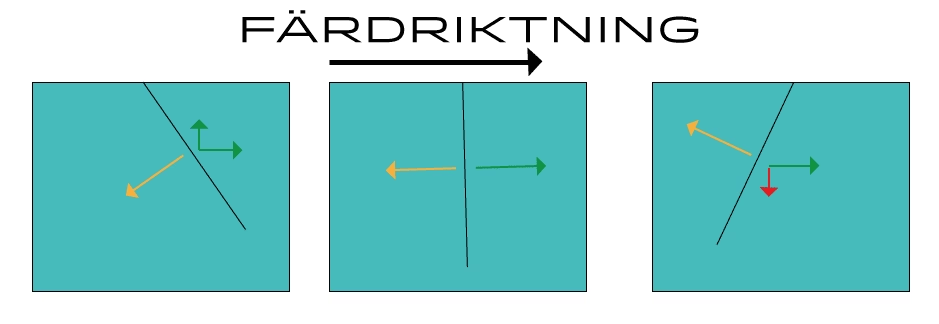
In the image above, the black line symbolizes the angle of the paddle blade, the yellow arrow represents the force the blade exerts on the water, and the green/red arrows represent the force transferred to our sea kayak. This is a simplified explanation, but it helps in understanding how we can direct the force.
With a positive angle (left image), our sea kayak receives force both forward and upward. The upward force provides support from the paddle, meaning we can lean on it more and feel secure. This sense of safety allows us to confidently engage our larger muscle groups.
The middle image shows a neutral angle with a vertical blade, providing full forward power. Theoretically, this is the most efficient direction for our force, as no energy is wasted in directions we don’t intend to go.
The final image on the right shows that a negative blade angle (which typically occurs when the paddle moves behind the body during a forward stroke) generates energy forward and downward. We want to avoid downward energy as it pulls the paddle into the water, potentially making us more unstable and less secure in our paddling. If we feel unstable, our ability to maintain good technique quickly diminishes.
Next time you go out, try experimenting to feel the differences between various paddle angles for yourself.
The Sea Kayak
Our sea kayak is controlled both by paddling techniques and by how the hull interacts with the water. The shape of the hull and its contact with the water influence the forces acting on the sea kayak. By learning to use the interaction between your sea kayak and the water to your advantage, you will become a more proficient paddler.
The sea kayak can be directed in three planes: Left/right (turning) and forward/backward; side to side (by edging the sea kayak); and up/down (which we call trimming the sea kayak, achieved by leaning forward or backward or by how the gear is loaded).
Forward/Backward/Turning (Direction)
Forward paddling is what we spend most of our time doing when sea kayaking, and it is what our sea kayaks are primarily designed for. The speed of our sea kayak influences how it responds when we adjust it in other directions and planes.
At more advanced levels, we often use a combination of different paddling techniques and hull adjustments through edging and trimming to steer our sea kayak exactly where we want it.
Edging & Leaning (Lateral Balance)
We can adjust our sea kayak’s edging to the right or left by shifting our center of gravity to the side. Edging means keeping our body inside the sea kayak’s center of gravity by shifting weight to one buttock and pressing the opposite thigh up against the deck. We use edging to facilitate more efficient and controlled turns.
Leaning means the body moves outside the sea kayak’s center of gravity. We maintain a neutral posture in the sea kayak and angle the entire body along with the boat. Leaning can be used, for example, when you want to turn at speed in combination with high or low bracing.
By edging or leaning our sea kayak, we change the hull’s contact with the water which, when applied correctly, helps us achieve more effective paddling technique and better control of our boat.
Trimming (longitudinal balance)
Trimming your sea kayak involves adjusting the center of gravity so it is further forward or further back. To achieve this, you lean your torso forward or backward, making the sea kayak as heavy as possible in the direction you wish to trim.
By leaning forward and pressing down the bow of the sea kayak, you can facilitate turns up into the wind.
Optimization

At the top of the pyramid, we find optimization and feel. Optimization is about connecting the various elements of the pyramid and discovering how it should feel when performed correctly. Optimization is something that can be refined indefinitely; it is the fine-tuning that distinguishes a good paddler from a truly great one.
Feel
As you progress in your sea kayaking Sweden adventures, a good goal is for it to “feel right.” To achieve this, you need to learn what the sensation of correct technique feels like.
Unfortunately, an incorrectly learned technique can also feel right. Therefore, it is vital to learn correctly from the start, and I always recommend a safety course with a certified instructor to build a solid foundation for your future paddling.
During our courses, I often encourage my participants to focus their attention on how it feels when they do it right. By regularly checking in with these sensations, we help the body remember, making it easier to return to that optimal feel.
The feel of paddling also involves rhythm, timing, and finding a joyful flow in your movement.
Timing
When we begin optimizing our paddling technique, we enter the realms of timing and tactics. It is about finding the music in your paddling and interacting harmoniously with the waves and wind.
Timing is a skill that requires your movements to become automated, which happens after significant practice and experience.
When you watch a paddler with great timing, it often looks effortless. They interact with the waves and wind, using their body, sea kayak, and paddle to guide the boat exactly where desired.
Frequency
Frequency, or cadence, is measured by how many paddle strokes you take per minute. If we use the same paddle and maintain a high frequency, it requires more power and provides more speed relative to the water than a low frequency. A low frequency results in lower speed but conserves energy.
During a sea kayak trip, it is important to adapt and change your frequency according to the prevailing conditions and surroundings. With a frequency that is too high, you may tire unnecessarily, while a frequency that is too low might result in not reaching your destination.
Relaxation – Tension
The final part of optimization is the feeling and control over relaxation and tension. Relaxation provides the muscles with oxygen for continued work. Paddling becomes much easier if we can find a technique where we allow unused muscles to rest.
In paddling, we have a natural rest phase called the glide phase (You can read more about the glide phase and the various stroke phases here).
When we take our paddle stroke, we engage the muscles. Here, we focus on tensing and activating the correct muscles at the right moment to paddle as efficiently as possible.
Summary
Whether your goal is to become a world champion or to enjoy a peaceful tour around the granite skerries of Bohuslän, mastering proper technique is an invaluable investment.
We hope that by following this series, you can find inspiration, lessons, and new knowledge to take your paddling to the next level.
If you have any questions or thoughts, do not hesitate to contact us and we will get back to you as soon as we can.


Leave a Reply