
If you have ever bought or rented a sea kayak, you have certainly been asked – do you want a rudder or a skeg?
Countless discussions have explored this question, and the interesting thing is that there isn’t one single answer. It simply depends on what you plan to do!
Without either a rudder or a skeg, your sea kayak will naturally want to turn into the wind. This means that unless you’re one of those who loves paddling into a headwind, you’ll need to compensate for the wind’s effect on your sea kayak, which can be tiring for the body over time.
But which is right for you: a rudder or a skeg? And how do they actually work?
How does a rudder work on a sea kayak?
On a sea kayak, the rudder is located at the stern and is deployed into the water when needed. It is connected by rudder lines to pedals in the cockpit, allowing you to easily control the steering with your feet. Press right to turn right, or left to turn left.
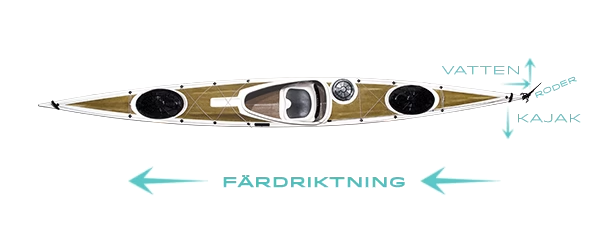
The image above shows a simplified view of how a rudder works. When the paddler presses the pedal with their right foot, the rudder angles to the right (upward in the image). Water then flows against the rudder, directing the water to the right. The force from the water is transferred to the stern of the sea kayak, which then moves to the left (downward). The sea kayak turns right, though it is actually the stern moving to the left.
Since the water flow provides the force to turn, the sea kayak must be moving forward for a rudder to work. The more speed you have, the more hydrodynamic force is generated = faster turns.
How does a skeg work on a sea kayak?
A skeg is a “fin” located in the stern of the sea kayak. It can be adjusted up and down but does not move sideways like a rudder. Therefore, the skeg is primarily used to compensate for the wind’s effect on the sea kayak, while you use your paddle and various steering strokes to turn your sea kayak.
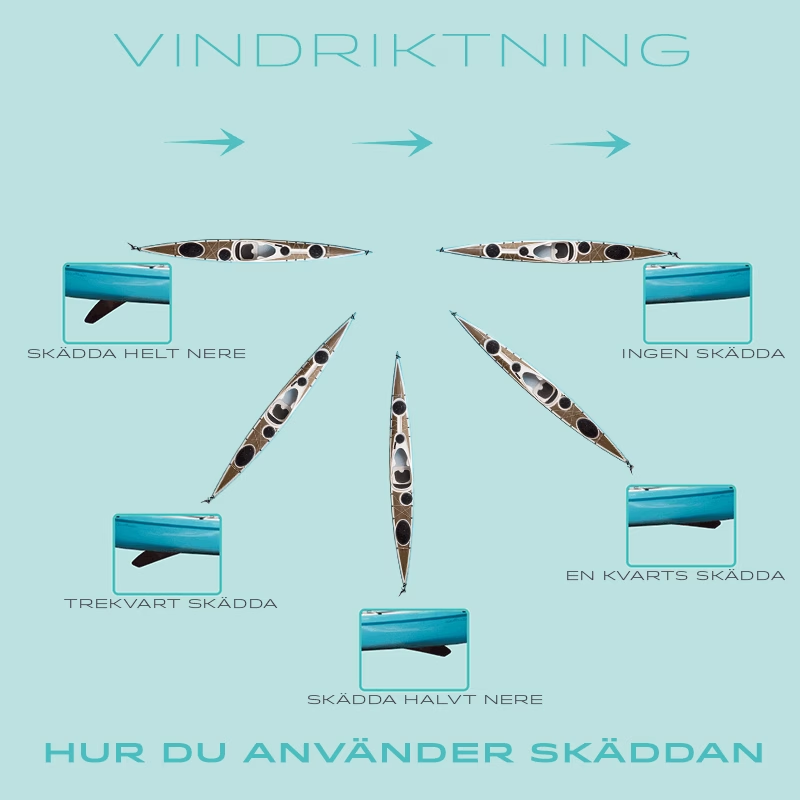
A common misconception is that a skeg is either just “on” or “off.” In reality, it is a precision tool that you can fine-tune to make your sea kayak behave exactly as you wish, regardless of the weather conditions.
The rule of thumb I usually teach during our safety courses is that if you want to turn up into the wind, you should pull up your skeg (slide the control forward). If you want to turn away from the wind, you should put down your skeg (pull the control towards you). In other words—if you want to paddle straight but feel your sea kayak turning into the wind, lower the skeg slightly. If it turns away from the wind, raise the skeg. This way, you can fine-tune until your sea kayak tracks straight regardless of wind conditions.
To truly learn and understand, I recommend experimenting to see if you can turn your sea kayak using only the skeg. This is an excellent exercise for gaining an intuitive feel for how the skeg works. Personally, I am always active with it while paddling, fine-tuning so my sea kayak always behaves exactly as I want.
The theory behind weathercocking (advanced level)
The reason a sea kayak turns into the wind—known as weathercocking—is because the bow (the front of the sea kayak) gets “stuck” in fresh water as it moves forward, while the stern slides through turbulent water and becomes much easier to move sideways. As a result, when the wind hits the sea kayak, the bow is harder to move than the stern, causing the sea kayak to turn into the wind. Or more accurately, the stern moves away from the wind faster than the bow does.
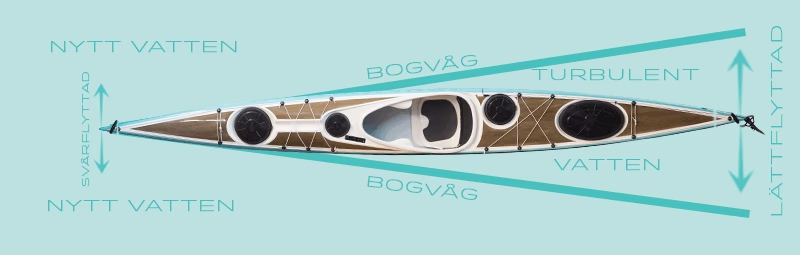
When we deploy the skeg, we make it harder for the stern to move sideways. Once we reach equilibrium—where it’s equally difficult to move the stern and the bow sideways—the sea kayak will maintain a straight course.
Rudder or Skeg – Which should I choose?
As you now know, a skeg and a rudder are two very different tools, and comparing them directly is difficult. It simply comes down to your personal paddling style and how you plan to use your sea kayak.
If you prefer focusing on forward paddling and moving efficiently through the water, I would recommend a sea kayak equipped with a rudder. If you enjoy a more playful style, using your body and edging to steer, I recommend a sea kayak with a skeg.
Personally, I enjoy paddling with just a skeg when I am out for a day trip. For longer expeditions or major crossings, I prefer the added control of a rudder.
When you are looking to buy a sea kayak, it simply comes down to how you plan to use it. Today, many sea kayaks are equipped with both a skeg and a rudder, which is very practical as you do not have to choose. Personally, I currently paddle a Melker Rödlöga that has both a rudder and a skeg. The rudder is retracted in most situations as I find it more joyful to focus on my paddling technique with only the skeg, and I am even considering removing it.
Which do you prefer to use most for your paddling adventures?


Leave a Reply