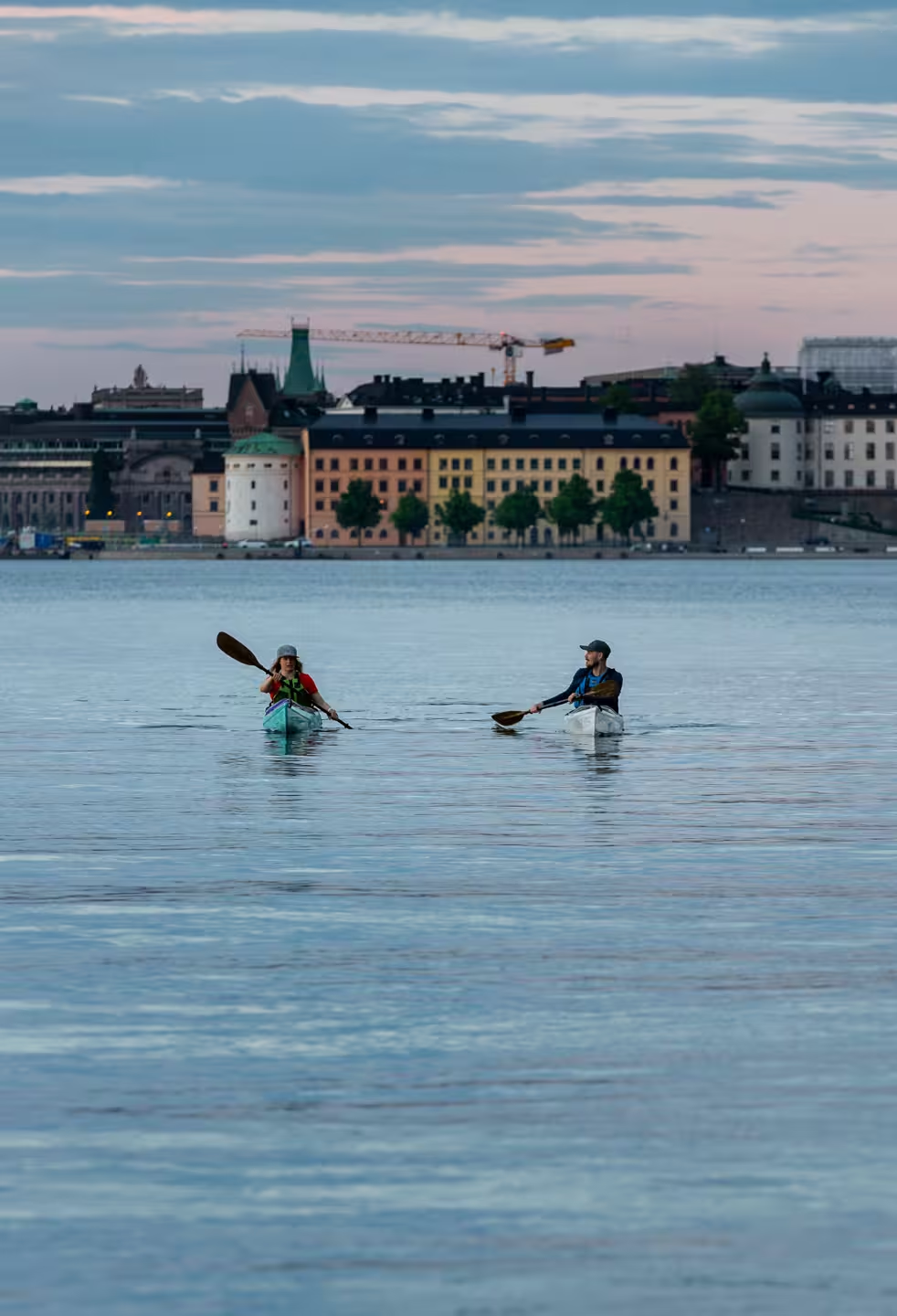
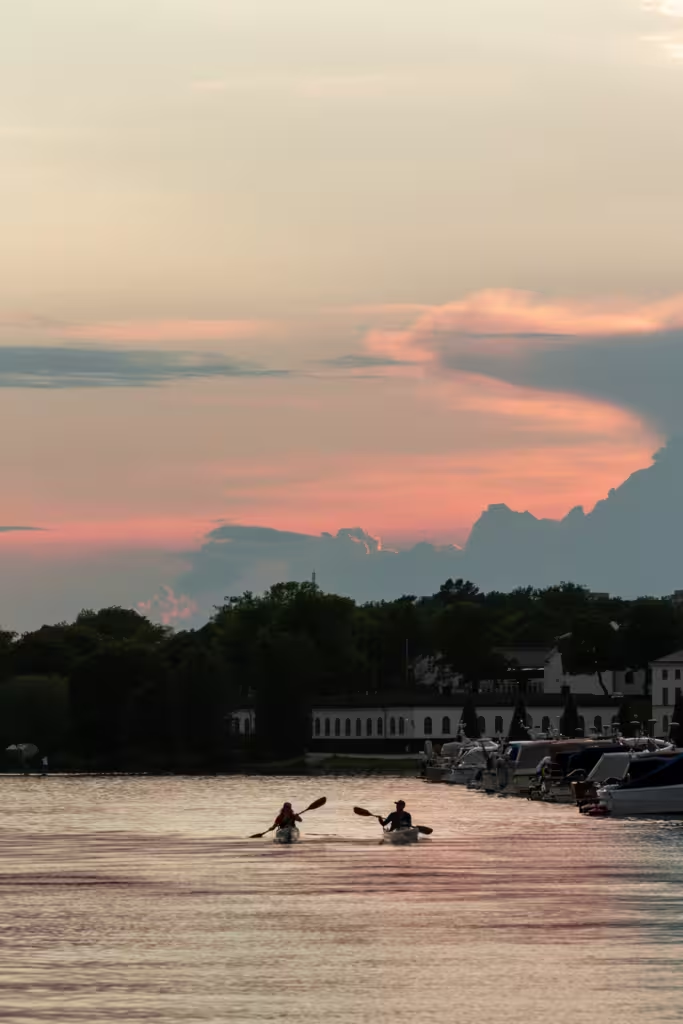
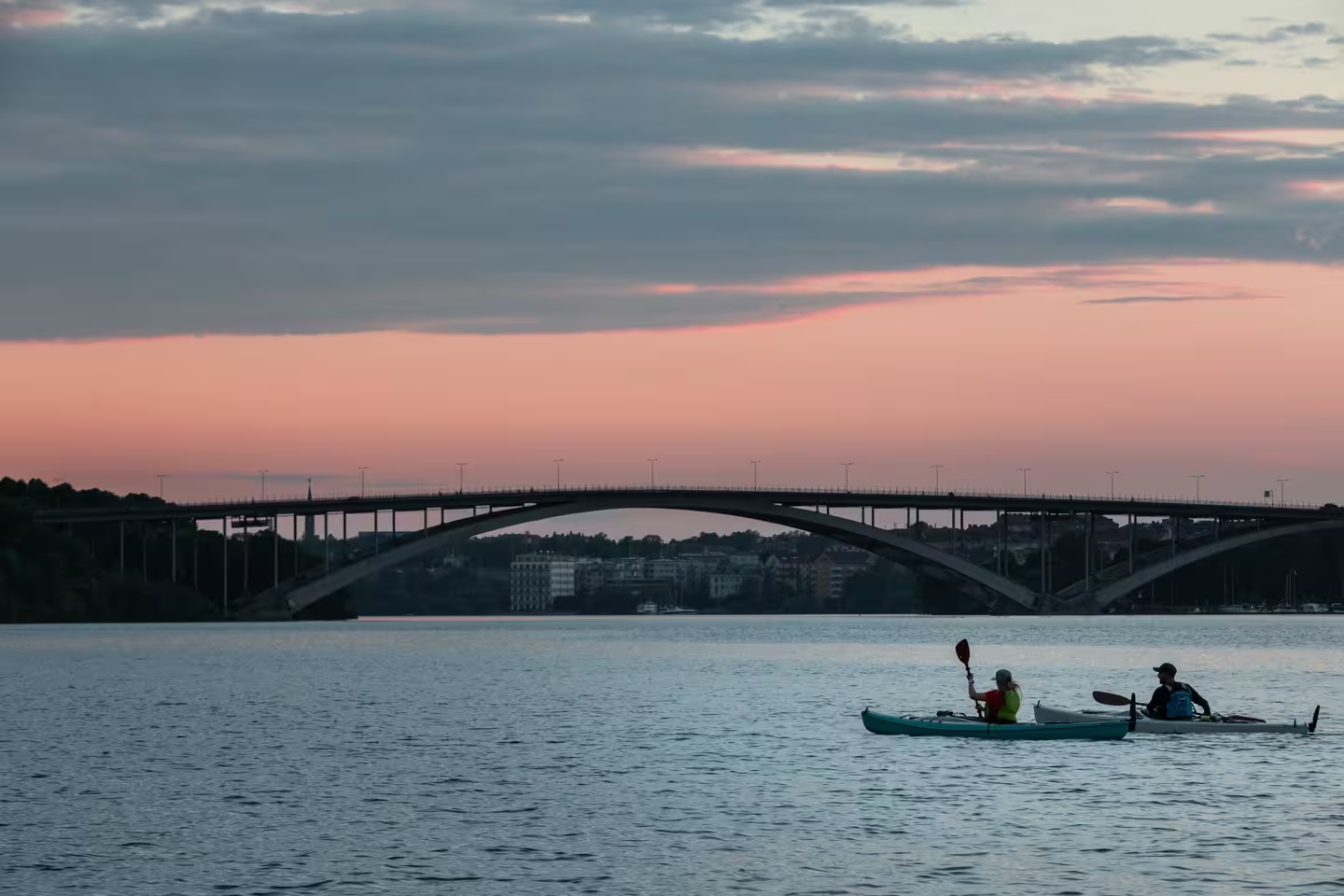
Christmas is approaching and one of the year’s most cozy traditions is drawing near – the Lucia Paddle! It is a truly special experience to glide through Stockholm as darkness falls, illuminated by fairy lights, candles, and wonderful community.
Are you eager to join the grand Lucia procession on the water but lack your own winter gear? No problem. We at Lek mer kajak & SUP ensure you can enjoy the evening warm and safe.
We are now offering gear rentals specifically for this event. The package includes not only a Sea Kayak but also the most essential item for the season – a drysuit. With the right clothing, winter paddling becomes a pure joy and you will stay dry and happy throughout the tour.
This is a perfect opportunity to experience the magic of winter paddling in a safe and atmospheric setting. Secure your gear today via our booking page and we’ll see you in the crowd!
Time and place: All detailed information regarding the meeting point, route, and times can be found in the official Facebook event: Luciapaddling Stockholm
Book a SUP or BIG SUP and join us for a movie screening on the water
We depart at 18:00 from Eden Kayak & SUP; the movie begins at 19:00
The movie is 2 hours long, and we expect to be back by 22:00 at the latest
Snacks?
Of course, feel free to bring snacks and your choice of beverage. However, we recommend a maximum of one alcoholic drink since we are on the water.
Our instructors will be on the water to help with positioning to ensure the best possible experience. However, please keep in mind that being on the water means waves and wind always add an element of adventure, so we cannot guarantee a perfectly static position.
Bring swimwear; it looks like it will be a warm and lovely evening with perfect conditions for a movie on the water!
We are finally launching Group SUP again! Every Wednesday throughout the summer, we gather for social stand-up paddling in Stockholm. This is a perfect activity for those looking to meet new people, discover paddling technique at a relaxed pace, and have fun on the water – whether you are a beginner or an experienced paddler.
Group SUP is our social paddling evening where we choose a route together and conclude with a shared drink at Eden. No prior experience is required; the only requirement is that you can swim. We learn from and with each other in a safe and supportive environment!
Price: 299 SEK (including board rental) When: Wednesdays throughout the summer, 18:00 Location: Eden Kajak & SUP, Smedsudden, Stockholm
If you have ever bought or rented a sea kayak, you have certainly been asked – do you want a rudder or a skeg?
Countless discussions have explored this question, and the interesting thing is that there isn’t one single answer. It simply depends on what you plan to do!
Without either a rudder or a skeg, your sea kayak will naturally want to turn into the wind. This means that unless you’re one of those who loves paddling into a headwind, you’ll need to compensate for the wind’s effect on your sea kayak, which can be tiring for the body over time.
But which is right for you: a rudder or a skeg? And how do they actually work?
How does a rudder work on a sea kayak?
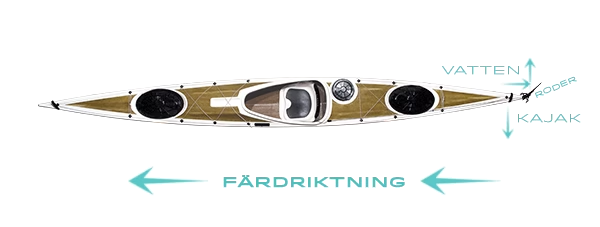
On a sea kayak, the rudder is located at the stern and is deployed into the water when needed. It is connected by rudder lines to pedals in the cockpit, allowing you to easily control the steering with your feet. Press right to turn right, or left to turn left.
The image above shows a simplified view of how a rudder works. When the paddler presses the pedal with their right foot, the rudder angles to the right (upward in the image). Water then flows against the rudder, directing the water to the right. The force from the water is transferred to the stern of the sea kayak, which then moves to the left (downward). The sea kayak turns right, though it is actually the stern moving to the left.
Since the water flow provides the force to turn, the sea kayak must be moving forward for a rudder to work. The more speed you have, the more hydrodynamic force is generated = faster turns.
How does a skeg work on a sea kayak?
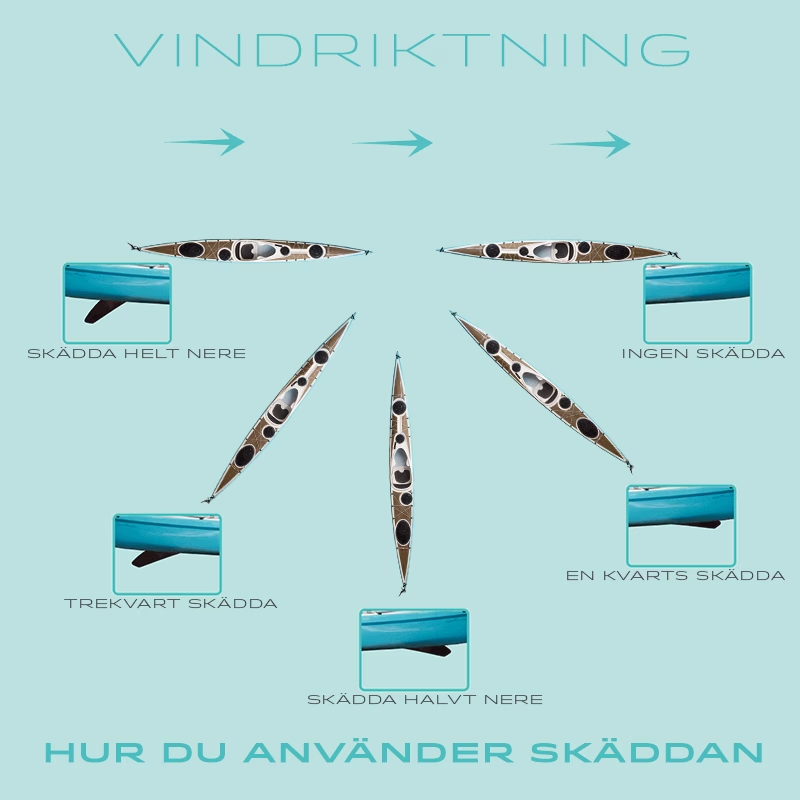
A skeg is a “fin” located in the stern of the sea kayak. It can be adjusted up and down but does not move sideways like a rudder. Therefore, the skeg is primarily used to compensate for the wind’s effect on the sea kayak, while you use your paddle and various steering strokes to turn your sea kayak.
A common misconception is that a skeg is either just “on” or “off.” In reality, it is a precision tool that you can fine-tune to make your sea kayak behave exactly as you wish, regardless of the weather conditions.
The rule of thumb I usually teach during our safety courses is that if you want to turn up into the wind, you should pull up your skeg (slide the control forward). If you want to turn away from the wind, you should put down your skeg (pull the control towards you). In other words—if you want to paddle straight but feel your sea kayak turning into the wind, lower the skeg slightly. If it turns away from the wind, raise the skeg. This way, you can fine-tune until your sea kayak tracks straight regardless of wind conditions.
To truly learn and understand, I recommend experimenting to see if you can turn your sea kayak using only the skeg. This is an excellent exercise for gaining an intuitive feel for how the skeg works. Personally, I am always active with it while paddling, fine-tuning so my sea kayak always behaves exactly as I want.
The theory behind weathercocking (advanced level)
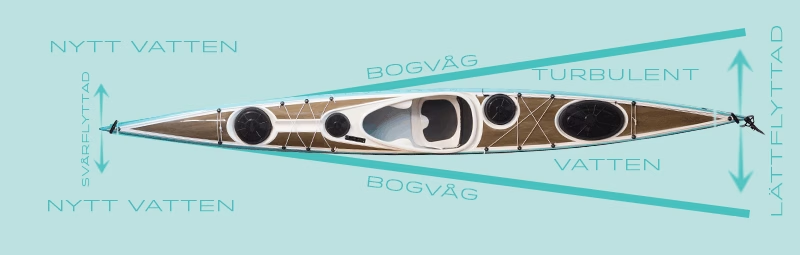
The reason a sea kayak turns into the wind—known as weathercocking—is because the bow (the front of the sea kayak) gets “stuck” in fresh water as it moves forward, while the stern slides through turbulent water and becomes much easier to move sideways. As a result, when the wind hits the sea kayak, the bow is harder to move than the stern, causing the sea kayak to turn into the wind. Or more accurately, the stern moves away from the wind faster than the bow does.
When we deploy the skeg, we make it harder for the stern to move sideways. Once we reach equilibrium—where it’s equally difficult to move the stern and the bow sideways—the sea kayak will maintain a straight course.
Rudder or Skeg – Which should I choose?
As you now know, a skeg and a rudder are two very different tools, and comparing them directly is difficult. It simply comes down to your personal paddling style and how you plan to use your sea kayak.
If you prefer focusing on forward paddling and moving efficiently through the water, I would recommend a sea kayak equipped with a rudder. If you enjoy a more playful style, using your body and edging to steer, I recommend a sea kayak with a skeg.
Personally, I enjoy paddling with just a skeg when I am out for a day trip. For longer expeditions or major crossings, I prefer the added control of a rudder.
When you are looking to buy a sea kayak, it simply comes down to how you plan to use it. Today, many sea kayaks are equipped with both a skeg and a rudder, which is very practical as you do not have to choose. Personally, I currently paddle a Melker Rödlöga that has both a rudder and a skeg. The rudder is retracted in most situations as I find it more joyful to focus on my paddling technique with only the skeg, and I am even considering removing it.
Which do you prefer to use most for your paddling adventures?
Stockholm – a city on the water. Few cities in the world offer such a unique combination of vibrant city life and tranquil nature as our beautiful capital. What better way to experience this contrast than from a kayak, gliding along glimmering waterways, with historic buildings and lush parks as your backdrop?
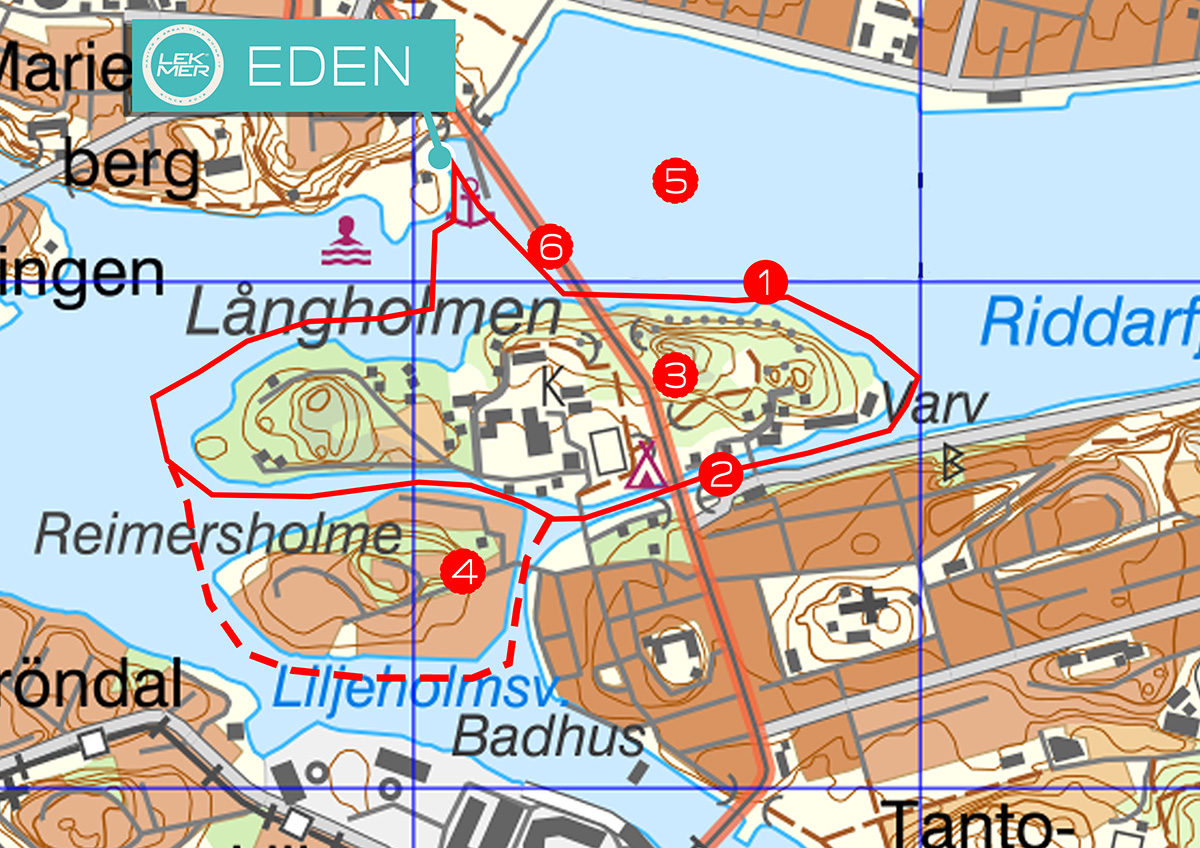
In this tour guide, I take you on a kayak tour around Långholmen and Reimersholme, a tour suitable for both beginners and experienced paddlers. Here awaits an exciting mix of history, culture and nature experiences, all within easy reach of Stockholm city center and our rental Eden Kayak & SUP.
Preparation and Practical Information
The tour starts at Eden Kayak & SUP, an idyllic oasis in the middle of Kungsholmen. Here you will be met by our knowledgeable staff who will help you with kayak and equipment. After a short review of safety and paddling techniques, it’s time to get out on the water.
Tips:
Direction: You want a tailwind on Riddarfjärden when you paddle around Långholmen, so choose your route according to the wind. Ask our staff on site about the best route for the day.
Rest areas: There are several places to take a break. Make sure to bring water and snacks! Some of the best places for a break include Långholmens klippbad or any jetty in the canal between Långholmen and Reimersholme.
Alternative routes: This tour has 2 different alternative routes. Either you choose to just paddle around Långholmen, or if you want to paddle a little further, you can add to also paddle around Reimersholme.
Highlights of paddling around Långholmen
Långholmen has worn many hats over the years. It was once home to a notorious prison, which operated from the 18th century until 1975. The legendary Lasse-Maja was imprisoned here, among others. Today, the prison has been converted into a unique hotel, where guests can sleep in the old cells.
But Långholmen is much more than just its prison history. Today, the island is a popular recreational area with something for everyone. There are lush parks perfect for picnics and relaxation, swimming spots for those who want to take a dip, and even a dog bath where our four-legged friends can cool off in the summer heat.
I have selected some highlights and described them in chronological order for those paddling clockwise around the island.
1. Långholmens klippbad – a dog bath in the middle of town
As you start your paddle along the northern side of Långholmen, you pass a headland with beaches on both sides. Here you’ll find Långholmen’s dog & rock bath, a place where dogs and their owners are welcome to swim and run freely. The northeastern part of Långholmen where the bath is located is one of Stockholm’s dog walking areas, here dogs are allowed to walk without a leash and run freely (as long as their owners have full control over them).
2. Pålsundet – a living maritime environment
Once you have passed the eastern tip of Långholmen and the marina, you will enter the lush and beautiful Pålsundet.
Pålsundet is a unique marine environment in the middle of Stockholm, a place where the wings of history meet the pulse of today. Charming wooden boats from different eras line the quays, creating a picturesque and vibrant atmosphere.
Pålsundet is an important part of Stockholm’s maritime heritage. It is home to a unique collection of historic Swedish pleasure boats, framed by lush greenery. It is a place where you can experience the city’s maritime history up close.
When gliding slowly through Pålsundet, don’t forget to keep to the right as there are many boats passing in the narrow channel.
Read more about the Sound and the boats you see here
A dramatic event in Långholmen’s recent history is the crash of a JAS Gripen plane during an air show in 1994. The pilot managed to eject and was unharmed, but the plane crashed on the island and was totally destroyed. The incident attracted a lot of attention and is now part of Långholmen’s history.
When you come out of Pålsundet, you land in a small oasis of your own where we also come to a choice of route. Here you can choose to paddle a little further and round Reimersholme, or you can continue straight ahead along Långholmen. The large yellow buildings you see to the right on Långholmen are the old prison mentioned earlier.
4. Reimersholme – from liquor production to artistic oasis
Reimersholme is a former industrial island that was once known for its liquor production. Reimersholms Spritförädlings AB, which was founded in 1879 by Lars Olsson Smith, was located here. The factory produced, among other things, the well-known “Absolut Rent Brännvin”, now known worldwide as Absolut Vodka.
Today, liquor production is a thing of the past, and Reimersholme has been transformed into a creative and relaxed oasis. There are studios, galleries, cozy cafés and open jetties for anyone who wants to enjoy summer in Stockholm.
5. Riddarfjärden – The Blue Heart of Stockholm
After rounding the western tip of Långholmen, you’ll once again come out on the riddarfjärden. If you continue to follow Långholmen until you reach the red dot (red stick in the water) you will have one of Stockholm’s best photo opportunities. You’ll see the City Hall beautifully framed in the arch of Västerbron. Take the opportunity to take a picture!
It’s a powerful sight, with the City Hall, Riddarholm Church and the Royal Palace as majestic silhouettes against the sky.
Riddarfjärden is truly the blue heart of Stockholm, a place where the city’s history and beauty come together. The water sparkles with the sun, and the historic buildings are reflected in its surface. It’s a view that etches itself into your memory and fills you with awe.
6. Västerbron – a modern icon
In the midst of this historical setting, Västerbron towers up, a modern icon that connects Kungsholmen and Södermalm.
Västerbron is not only an important traffic route, but also a popular place for walking and sightseeing. From the bridge you have a great view of Riddarfjärden and the Stockholm city skyline. It’s a place to stop and admire the beauty of the city, and feel the presence of history.
Now it’s time to take you back to our little oasis on Eden, hope you had a magical trip!
Kayak rentals to paddle around Långholmen
If you want to rent a kayak or SUP and paddle around Långholmen, there are several different kayak rentals located in good locations. All have slightly different offers.
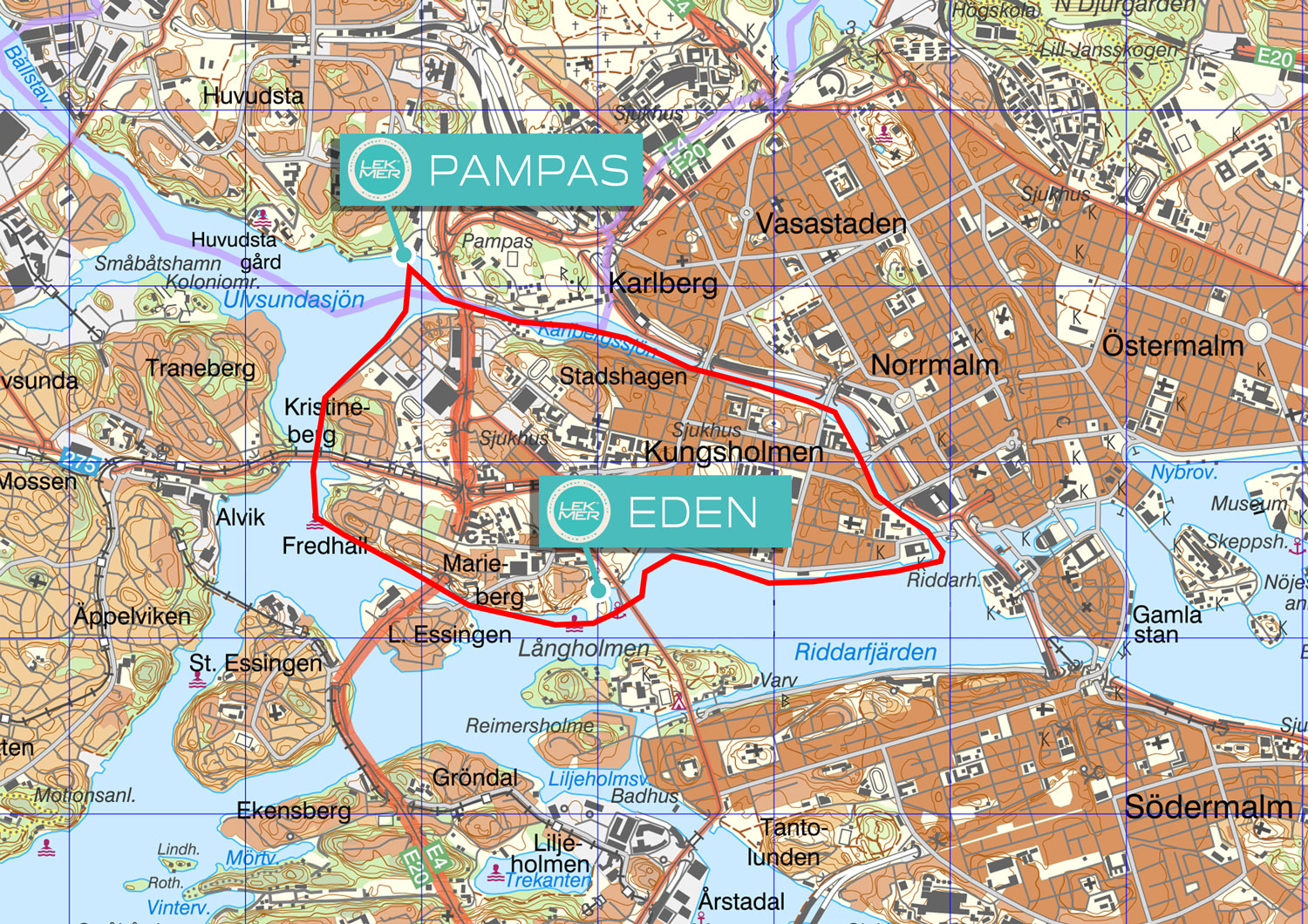
Eden Kajak & SUP – Approved canoe center located at Rålis (Rålambshovsparken). Invests in good equipment and high service.
Pampas Kayak & SUP – Located in Pampas marina, opposite Hornsbergsstrand and, like Eden, has a focus on high quality equipment that provides a more enjoyable experience on the water.
Stockholm SUP – Located at gröndal opposite Reimersholme, has stable and slightly more fun kayaks & SUP.
Långholmen kayak – Located on Långholmen and focuses on stable plastic kayaks.
The paddle around Långholmen is becoming what I would call a modern classic when it comes to kayak & SUP tours in Stockholm. It’s just long enough for everyone to be able to do it, while it has elements of everything from history to nature and city feeling.
Wishing you an amazing tour as you explore new perspectives of Stockholm from your kayak!
We are proud to announce that our Emil Gyllenberg has been appointed as a member of the Swedish Canoe Federation’s newly formed committee for recreational paddling. This committee is a vital part of the federation’s work to promote recreational paddling in Sweden and encourage more young people to discover the joy of the sport.
We look forward to seeing how Emil, together with the other committee members, will develop and implement new initiatives that promote the growth and accessibility of recreational paddling.
“It is a fantastic opportunity to be part of influencing paddling in Sweden on a larger scale, and I am super excited to help make a difference,” says Emil.
Welcome to our new blog series “Become a Better Paddler”! My goal with this series is to provide you with the tools to develop your paddling technique. I hope this will inspire more people to take the step and learn more. Regardless of your skill level, I hope you will appreciate and find something that helps you progress in your continued development on the water!
In this series, we will dive deep into various aspects of sea kayaking. We will work with one theme per month, and each blog post will be complemented by video(s) on YouTube and posts on our Facebook & Instagram.
There will be a significant focus on paddling technique, and I want to remind you that whether you aim to be the world’s best kayaker or your goal is to paddle a loop around Kungsholmen, good technique is an investment that quickly pays off. If you want to be the best, it is a necessity. If you just want to get out and discover the water, technique will be decisive for how efficiently you move and how safe you feel in various, often stunningly beautiful, environments.
The Technique Pyramid
Before we start looking at specific techniques, I want to introduce something that the Swedish Canoe Federation’s education committee has developed as a tool for analyzing paddling. We call it the Technique Pyramid.
This is just one model, and there are several others you can choose to use if you prefer. In this series, however, we will use the Technique Pyramid, so it might be wise to read on to gain an understanding of what it is and what it is intended to do.
What is the Technique Pyramid?
The Technique Pyramid is a model used in sea kayaking to understand and improve paddling technique. It breaks paddling down into basic components and highlights how these elements interact. The purpose of the pyramid is to provide a framework for both analyzing and developing paddling skills, which contributes to a more efficient, safe, and enjoyable experience on the water.
The different parts of the pyramid collectively contribute to good paddling technique. Each part can also be studied individually, which means that using the parts of the pyramid, we can analyze a paddler to identify areas for growth.
By understanding and training different parts of the pyramid, you as a paddler can develop systematically, whether you are a beginner or experienced. The pyramid can be used to create exercises focused on specific areas and to analyze paddling technique, making it easier to pinpoint which area can be improved.
Parts of the Pyramid
The Technique Pyramid is divided into four different parts, each with its respective components.
Foundations These are the essentials needed for paddling, the base of the pyramid. This includes having the right equipment for the paddler and the environment, as well as the paddler’s physical and mental state. A good position in the sea kayak is a vital foundation.
Power Transfer involves how the body moves to transfer energy from the body to the water to propel the sea kayak forward.
Directing Power focuses on how we use our paddle and sea kayak to apply and direct the power we create correctly.
Optimization is about how all parts of the paddle stroke are interconnected. It concerns the timing of movements, the ability to adjust the paddling tempo, and engaging or relaxing various muscle groups.
Foundations
Foundations are the base of the pyramid and of paddling itself. If you lack any of these, it becomes difficult to paddle in an efficient and safe manner. When I work as an instructor and something isn’t working for one of my students, this is always where I start looking. Are there any of these boxes we need to focus on?
If you join us for a safety course or learn from another authorized educator, these are typically the areas we work on at the yellow level of the “Paddelpasset” (Paddle Pass).
Below is a description of each part of the foundations.
Equipment
To be able to paddle at all, the right equipment must be in place. Correct equipment varies depending on where and when you paddle, but as a base, a paddle of appropriate length, a sea kayak that fits you well, and a PFD (Personal Flotation Device) adapted for paddling are essential foundations.
Physical
Your physical ability significantly impacts how well you can propel the sea kayak. The physical aspect is not just about strength; we also look at:
Balance is your ability to maintain equilibrium. Having good balance makes it easier to handle waves and other conditions encountered during sea kayaking in Sweden. In a sea kayak, basic balance comes from the hips, and we stay stable by keeping our center of gravity within the width of the sea kayak. A proper sitting position with good contact contributes to excellent balance.
Without balance, it becomes difficult for a paddler to develop good paddling technique. It also makes it harder to stay in a positive mental state, as your focus quickly shifts to keeping the sea kayak on an even keel.
Endurance is something every paddler needs. For those of us who don’t compete but are out for the experience and adventure, good fitness helps increase safety during your journey. Good endurance also makes your Bohuslän kayaking adventure through the granite skerries more enjoyable.
Strength allows us to execute our paddle strokes and propel our sea kayak forward. The stronger you are, the more power you can put into your strokes. When combined with good paddling technique, this creates efficient forward drive. Good core strength also reduces the risk of injury. In sea kayaking, strength and stability in the core and shoulders are the most vital muscle groups.
Motor skills & coordination are about your ability to synchronize different movements. Sea kayaking is a blend of several more or less complex movements that require motor skills and coordination to master.
Mobility is essential both for executing proper paddling technique and for avoiding injuries. When paddling, it is important to have good mobility in the thoracic spine and hamstrings. If your legs are too tight, it becomes difficult or impossible to maintain a good position in the sea kayak. A poor sitting position makes it hard to achieve good technique.
Position
A good position creates the foundation for efficient paddling. It provides the correct balance, strength, and the ability to move freely.
When sitting in your sea kayak, you want a forward-rotated pelvis with a slight arch in the lower back. You should sit with good posture and preferably a slight forward lean. To sit comfortably in the right position, your sea kayak needs to be correctly adjusted. Your footrests should be at a distance where you have good support and can maintain contact with your sea kayak through your feet, buttocks, and knees.
Correct sitting position leads to better control and balance in your sea kayak. If you find it difficult to sit well, it may be due to the following:
Overly tight hamstrings
Weak core muscles that cannot support the body
A seat that does not fit your body and therefore does not provide proper support
Footrests positioned too far away.
Another common “error” in positioning is sitting with forward-rotated shoulders. This can lead to shoulder issues and often results in jutting the head forward, which can cause neck discomfort.
To achieve a good shoulder position, you may need to train the muscles around the shoulder blades and stretch the chest muscles and the latissimus dorsi.
In addition to sitting position, hand placement is important to consider. In all paddling techniques, you want slightly bent arms and to look in the direction you are paddling.
Mental State
Being in the right mental state is not a strict prerequisite for being able to paddle. However, if you want to develop your skills and learn more, it is important to be in a good mental place. By being present in the moment, interested, and curious, you can stimulate your ability to absorb information.
When I, as an instructor, notice that the mental aspect is missing, it is often due to fear or anxiety. A person who is afraid is in survival mode, making it very difficult for them to process information. Therefore, I always work hard to create a safe environment when I lead a safety course and ensure that, especially when out with beginners, everyone has sea kayaks they feel secure in.
Contact
Last on the list of prerequisites is the contact between the body, the sea kayak, and the paddle. But also the contact of the paddle and the sea kayak with the water.
Good contact provides the right conditions for the power transfer from your body into the water through the paddle, and into the sea kayak through your contact points at the feet, knees, and buttocks.
When sitting in the sea kayak, we want contact with our feet on the sea kayak’s footrests and the bottom of the boat. Our buttocks and hips should have contact with the seat, and our knees (or inner thighs) should have contact with the inside of the sea kayak’s deck or the cockpit.
If you lack contact with the sea kayak, it is often noticeable through:
Poorer balance in the sea kayak
Poor sitting position (commonly leaning backward because the footrests are too far away)
Difficulty keeping the sea kayak on edge
Good contact between the paddle and the water is characterized by:
The entire blade being in the water during the power phase
Little to no bubbles/vortices in the water during the power phase.
By power phase, I mean the time when you apply force to the paddle blade in the water.
Power Transfer
Power transfer is about how we use the energy from both the body and the water to move our sea kayak. It involves how we transfer force through our body, through the paddle, and into the water, and how we use timing to leverage waves and currents to help propel our sea kayak forward.
The Body
To move and control our sea kayak, force from our body must be transferred to the water. This is achieved through what we call paddling techniques, and a key thing to remember is that our goal is to move the sea kayak, not the paddle.
When executing our paddling techniques, we want to engage the largest muscle groups possible. We want the power to originate from your thighs and core.
Imagine sitting in your sea kayak, ready for a forward stroke. You want to rotate your torso so the shoulder on the side where the paddle enters the water reaches as far forward as possible. Once the blade is submerged, rotate your body back while pushing your sea kayak forward with the leg on the same side as the paddle.
Maintaining good contact with the water and the sea kayak ensures these movements effectively propel your sea kayak forward.
A great way to feel the difference in power between using your arms versus your core is to have a friend hold your paddle blade while you sit on land. First, try moving the paddle using only your arms. Then, try engaging your core.
To summarize, the body’s role in power transfer is about finding and activating the right muscles to move our sea kayak.
The Water
When sea kayaking, we often encounter water with its own kinetic energy in the form of waves or currents. We can harness this energy to our advantage to move our sea kayak. Perhaps you have even tried surfing a wave?
Learning to read and feel the movement of the water is a skill that takes time and practice, but it is incredibly rewarding when you start feeling comfortable in it!
Directing the Force
To make our sea kayak respond as intended, the force transferred from the body or the water’s movement must be directed correctly. We can direct the force and control the sea kayak’s movement by positioning or angling our paddle blade and by edging our sea kayak. There are also more or less favorable angles to work with for optimal drive.
The Paddle
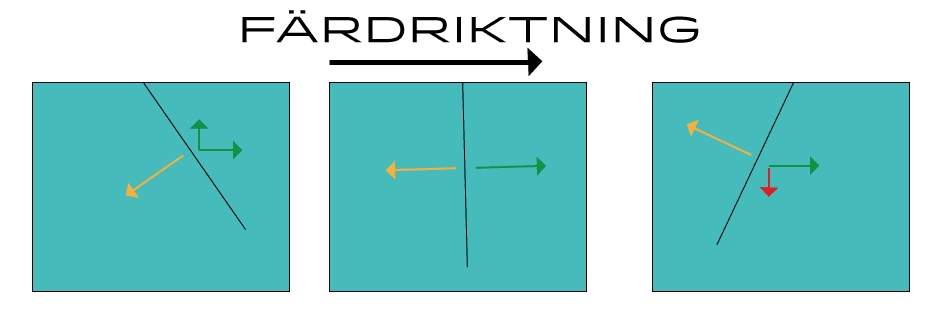
When discussing the paddle and its angles, we often say the blade should maintain a positive to neutral angle relative to our intended direction. To make this easier to understand, I usually talk about the physics of force vectors.
In the image above, the black line symbolizes the angle of the paddle blade, the yellow arrow represents the force the blade exerts on the water, and the green/red arrows represent the force transferred to our sea kayak. This is a simplified explanation, but it helps in understanding how we can direct the force.
With a positive angle (left image), our sea kayak receives force both forward and upward. The upward force provides support from the paddle, meaning we can lean on it more and feel secure. This sense of safety allows us to confidently engage our larger muscle groups.
The middle image shows a neutral angle with a vertical blade, providing full forward power. Theoretically, this is the most efficient direction for our force, as no energy is wasted in directions we don’t intend to go.
The final image on the right shows that a negative blade angle (which typically occurs when the paddle moves behind the body during a forward stroke) generates energy forward and downward. We want to avoid downward energy as it pulls the paddle into the water, potentially making us more unstable and less secure in our paddling. If we feel unstable, our ability to maintain good technique quickly diminishes.
Next time you go out, try experimenting to feel the differences between various paddle angles for yourself.
The Sea Kayak
Our sea kayak is controlled both by paddling techniques and by how the hull interacts with the water. The shape of the hull and its contact with the water influence the forces acting on the sea kayak. By learning to use the interaction between your sea kayak and the water to your advantage, you will become a more proficient paddler.
The sea kayak can be directed in three planes: Left/right (turning) and forward/backward; side to side (by edging the sea kayak); and up/down (which we call trimming the sea kayak, achieved by leaning forward or backward or by how the gear is loaded).
Forward/Backward/Turning (Direction)
Forward paddling is what we spend most of our time doing when sea kayaking, and it is what our sea kayaks are primarily designed for. The speed of our sea kayak influences how it responds when we adjust it in other directions and planes.
At more advanced levels, we often use a combination of different paddling techniques and hull adjustments through edging and trimming to steer our sea kayak exactly where we want it.
Edging & Leaning (Lateral Balance)
We can adjust our sea kayak’s edging to the right or left by shifting our center of gravity to the side. Edging means keeping our body inside the sea kayak’s center of gravity by shifting weight to one buttock and pressing the opposite thigh up against the deck. We use edging to facilitate more efficient and controlled turns.
Leaning means the body moves outside the sea kayak’s center of gravity. We maintain a neutral posture in the sea kayak and angle the entire body along with the boat. Leaning can be used, for example, when you want to turn at speed in combination with high or low bracing.
By edging or leaning our sea kayak, we change the hull’s contact with the water which, when applied correctly, helps us achieve more effective paddling technique and better control of our boat.
Trimming (longitudinal balance)
Trimming your sea kayak involves adjusting the center of gravity so it is further forward or further back. To achieve this, you lean your torso forward or backward, making the sea kayak as heavy as possible in the direction you wish to trim.
By leaning forward and pressing down the bow of the sea kayak, you can facilitate turns up into the wind.
Optimization
At the top of the pyramid, we find optimization and feel. Optimization is about connecting the various elements of the pyramid and discovering how it should feel when performed correctly. Optimization is something that can be refined indefinitely; it is the fine-tuning that distinguishes a good paddler from a truly great one.
Feel
As you progress in your sea kayaking Sweden adventures, a good goal is for it to “feel right.” To achieve this, you need to learn what the sensation of correct technique feels like.
Unfortunately, an incorrectly learned technique can also feel right. Therefore, it is vital to learn correctly from the start, and I always recommend a safety course with a certified instructor to build a solid foundation for your future paddling.
During our courses, I often encourage my participants to focus their attention on how it feels when they do it right. By regularly checking in with these sensations, we help the body remember, making it easier to return to that optimal feel.
The feel of paddling also involves rhythm, timing, and finding a joyful flow in your movement.
Timing
When we begin optimizing our paddling technique, we enter the realms of timing and tactics. It is about finding the music in your paddling and interacting harmoniously with the waves and wind.
Timing is a skill that requires your movements to become automated, which happens after significant practice and experience.
When you watch a paddler with great timing, it often looks effortless. They interact with the waves and wind, using their body, sea kayak, and paddle to guide the boat exactly where desired.
Frequency
Frequency, or cadence, is measured by how many paddle strokes you take per minute. If we use the same paddle and maintain a high frequency, it requires more power and provides more speed relative to the water than a low frequency. A low frequency results in lower speed but conserves energy.
During a sea kayak trip, it is important to adapt and change your frequency according to the prevailing conditions and surroundings. With a frequency that is too high, you may tire unnecessarily, while a frequency that is too low might result in not reaching your destination.
Relaxation – Tension
The final part of optimization is the feeling and control over relaxation and tension. Relaxation provides the muscles with oxygen for continued work. Paddling becomes much easier if we can find a technique where we allow unused muscles to rest.
When we take our paddle stroke, we engage the muscles. Here, we focus on tensing and activating the correct muscles at the right moment to paddle as efficiently as possible.
Summary
Whether your goal is to become a world champion or to enjoy a peaceful tour around the granite skerries of Bohuslän, mastering proper technique is an invaluable investment.
We hope that by following this series, you can find inspiration, lessons, and new knowledge to take your paddling to the next level.
If you have any questions or thoughts, do not hesitate to contact us and we will get back to you as soon as we can.
We are happy to announce that LEK MER | Sea Kayak & SUP now stands on its own feet as an independent company, after previously being part of Melker of Sweden. This change marks the beginning of an exciting new era for us.
Emil, who is now the owner of LEK MER, has been a central figure within Melker and has been responsible for LEK MER’s operations for several years. With his deep commitment and experience, he will now dedicate himself wholeheartedly to driving LEK MER forward.
This change means we will focus even more on realizing our vision – to make paddling accessible and fun for everyone, with a strong emphasis on safety and service. We look forward to continuing to develop our services and offering unforgettable sea kayaking Sweden experiences for both beginners and experienced paddlers.
We will continue to have a close collaboration with Melker and look forward to building on this foundation with new opportunities and challenges. Together with our customers and partners, we are ready to paddle into the future with LEK MER | Sea Kayak & SUP as an independent company.
Join us and follow our journey on this exciting path!
We are proud to present our new memberships, giving you the opportunity to explore and enjoy sea kayaking at both Eden and Pampas. Whether you are an enthusiastic beginner or an experienced paddler, our memberships offer something for everyone and are designed to enhance your experience while strengthening our community. How about the freedom to paddle as much as you want, when you want?!
What do our memberships offer?
Exclusive Benefits: From 10-100% discount on paddling, discounts on safety courses and events, and the chance to join member tours.
Flexibility and Choice: Four different membership levels to suit your needs and interests, whether you are just starting out or are an experienced sea kayaker.
Community and Growth: Join our paddling family and enjoy shared tours in the beautiful waters of the Stockholm archipelago.
Why become a member?
Our goal is to create an inclusive and educational environment where everyone can enjoy the joy of paddling and develop their skills safely. By becoming a member, you support our vision to be a central hub for sea kayaking in Stockholm.
How do you become a member?
Visit our membership page for more information on membership levels and how to register. We look forward to welcoming you to our growing paddling community!
Stockholm is not only Sweden’s capital; it is a city of islands, history, and countless adventures. One of the most popular sea kayaking tours is “Around Kungsholmen”, an experience that combines the city’s beauty with its rich history. This tour, spanning approximately 10 km, gives paddlers a unique opportunity to experience Stockholm from the water. Here is everything you need to know to join us on this adventure.
Preparation and Practical Information
Before you head out to paddle around Kungsholmen, proper preparation is essential. The tour usually takes about two hours in a sea kayak, but this may vary based on weather conditions, wind speed, and how many breaks you choose to take. For extra safety and to get a closer look at the sights along the shoreline, I recommend staying close to land. By paddling around Kungsholmen, you get the chance to see the city from a whole new perspective, where the impressive buildings and surrounding nature truly come to life.
Essential Tips:
Direction: In easterly or southeasterly winds, paddle clockwise around the island. In westerly or southwesterly winds, paddle counter-clockwise for the most pleasant journey. Feel free to talk to our staff about the best paddling direction for today.
Rest Areas: There are several recommended spots for a break. Ensure you bring water and snacks! Some of the best places for a rest are the north side of Långholmen, Rålambshovsparken, and Karlberg Palace.
Historical Highlights around Kungsholmen
Around Kungsholmen is not just a physical challenge; it is a journey through history. Here are some of the most interesting sights we encounter.
The History of Lake Mälaren
Lake Mälaren, Sweden’s third-largest lake, stretches 120 km inland from the Old Town (Gamla Stan) and is home to about 7,500 islands. The lake is a vital source of drinking water for 2.5 million people in the region. The name comes from the Old Swedish word “mal,” meaning coarse gravel, reflecting the lake’s geological history.
After the ice sheet melted 10,000 years ago, the land began to rise, and Lake Mälaren—which was previously part of the Baltic Sea—became a lake. Archaeological finds show that people have lived here for over 8,000 years, sustained by hunting and fishing. Despite the city’s expansion, traces of ancient settlements remain in the area. Lake Mälaren offers a beautiful environment to explore from your sea kayak.
Karlberg Palace
The beautiful Karlberg Palace, built in the 1630s, is now a military academy. It is the world’s oldest military academy still in use at its original location. The palace has a rich history and has housed many royal families over the years. You can feel the wings of history as you paddle past.
Sankt Eriksbron Bridge
When you paddle under Sankt Eriksbron, you are at a fascinating example of 20th-century industrial development. The original bridge was built in 1909, but the current steel beam bridge was installed in 1937 to handle increasing car traffic. The bridge is unique in Stockholm as the only double-deck bridge, accommodating both cars and the subway.
During the bridge’s planning, preparations were already made for the subway, which began operating here in the 1950s. On the eastern side of the bridge sits a green building known as the Sport Palace (Sportpalatset), which once contained a 50-meter pool and other sports facilities. In the 1970s, the building became a recording studio for Polar Music, where ABBA and other international artists recorded their songs. The Sport Palace is part of Stockholm’s musical heritage and contributes to the area’s rich history.
The City Hall
City Hall, one of Stockholm’s most iconic buildings, is renowned for its unique architecture and historical significance. Designed by Ragnar Östberg and completed in 1923, the building harmoniously blends influences from Italian, Nordic, Gothic, and Islamic architecture. It is the heart of the city’s political life and every year hosts the Nobel Banquet in its magnificent halls.
City Hall is a masterpiece of the National Romantic style, constructed with 8 million specially made dark red bricks. The tower, rising 106 meters, offers a breathtaking view over the city. The building’s ornamentation is rich with references to Stockholm’s history, securing its place as a vital part of the city’s cultural heritage.
Västerbron
Västerbron, which opened for traffic in 1936, is an impressive steel arch bridge stretching across Riddarfjärden, connecting the districts of Södermalm and Kungsholmen. With a vertical clearance of 26 meters and a total length of over 600 meters including viaducts, it remains the largest steel bridge ever built in Sweden.
Before Västerbron was built, the only way to travel from north to south through the city was via Gamla Stan. The bridge significantly improved traffic flow and became a cornerstone of Stockholm’s infrastructure. Its architectural design and functionality make it one of the city’s most significant bridges, both historically and in today’s modern urban landscape.
Stora and Lilla Essingen
The Essinge Islands, consisting of Lilla and Stora Essingen, offer a fascinating look at Stockholm’s evolution from industrial hubs to attractive residential areas.
Lilla Essingen has undergone a significant transformation from an industrial island to a modern residential oasis. During the first half of the 20th century, the island was home to major industries like Primus and AB Lux, famous for their kerosene stoves and vacuum cleaners. Today, these factories have been replaced by modern homes, while some of the old brick buildings have been preserved and given new life as restaurants and residences. Lilla Essingen is now a peaceful spot with beautiful parks and promenades, perfect for a safe sea kayak break.
Stora Essingen, on the other hand, is known as Stockholm’s villa island. Development began with worker housing and summer cottages in the 1870s, and the island has since become an exclusive area with villas and apartment buildings. Situated near the busy Essingeleden, Stora Essingen offers a charming combination of city life and scenic nature, making it a popular choice for those seeking a calm environment near the city’s pulse.
Together, the Essinge Islands represent a dynamic part of Stockholm where history meets modernity in a harmonious environment.
The Hidden Gems of Kungsholmen
In addition to the historical sites, the tour offers beautiful views and modern features. Kungsholmen is a place where old meets new, which is clearly noticeable throughout your paddling trip.
Rålambshovsparken: A perfect spot for a break with a view over the water. Here you can stretch your legs and enjoy a picnic in the greenery.
Hornsbergs Strand: A newly developed area with swimming opportunities and restaurants, perfect for a concluding coffee. The excellent sunny location has made it a popular place to hang out, especially during the warm days of summer.
Sea kayak rental around Kungsholmen
For those looking to rent a sea kayak or SUP and paddle around Kungsholmen, there are several rental centers located on or near the island. Each offers unique services for your safety and enjoyment.
Eden Kayak & SUP – A certified canoe center located at Rålis (Rålambshovsparken). They focus on high-quality equipment and excellent service.
Pampas Kayak & SUP – Located in Pampas Marina, opposite Hornsbergs Strand; like Eden, they prioritize high-quality equipment to ensure a more joyful experience on the water.
Kajakkompaniet – Located under Tranebergsbron, offering quality sea kayaks.
Långholmen Kayak – Located on Långholmen and focuses on stable plastic kayaks.
Paddling around Kungsholmen is more than just a physical activity; it’s a chance to see Stockholm from a fresh perspective, a highlight of sea kayaking Sweden. Whether you are an experienced paddler or a beginner, this tour offers something for everyone. So rent a sea kayak, follow our guide, and experience one of Stockholm’s most beloved paddling routes.
We hope you have a fantastic tour and discover new sides of Stockholm from your sea kayak!
Hantera samtycke
För att ge en bra upplevelse använder vi teknik som cookies för att lagra och/eller komma åt enhetsinformation. När du samtycker till dessa tekniker kan vi behandla data som surfbeteende eller unika ID:n på denna webbplats. Om du inte samtycker eller om du återkallar ditt samtycke kan detta påverka vissa funktioner negativt.
Funktionell
Always active
Den tekniska lagringen eller åtkomsten är absolut nödvändig för det legitima syftet att möjliggöra användningen av en specifik tjänst som uttryckligen begärts av abonnenten eller användaren, eller för det enda syftet att utföra överföring av en kommunikation över ett elektroniskt kommunikationsnät.
Alternativ
Den tekniska lagringen eller åtkomsten är nödvändig för det legitima syftet att lagra inställningar som inte efterfrågas av abonnenten eller användaren.
Statistik
Den tekniska lagringen eller åtkomsten som används uteslutande för statistiska ändamål.Den tekniska lagringen eller åtkomsten som används uteslutande för anonyma statistiska ändamål. Utan en stämningsansökan, frivillig efterlevnad från din Internetleverantörs sida, eller ytterligare register från en tredje part, kan information som lagras eller hämtas endast för detta ändamål vanligtvis inte användas för att identifiera dig.
Marknadsföring
Den tekniska lagringen eller åtkomsten krävs för att skapa användarprofiler för att skicka reklam, eller för att spåra användaren på en webbplats eller över flera webbplatser för liknande marknadsföringsändamål.



![The Technique Pyramid consists of:
Foundations [equipment, physical, position, mental, contact]
Power Transfer [Water, Body]
Directing Power [Paddle, Kayak]
Optimization [feeling]](https://lekmer.nu/wp-content/uploads/2025/01/teknikpyramiden-png.avif)